
Navigating the Maze of GDPR Fines Calculation: A Guide for Austrian Businesses
The General Data Protection Regulation (GDPR) has introduced some of the most significant financial penalties in regulatory history. For businesses in Austria and across the European Union, non-compliance carries substantial risk. A major data breach can lead to fines amounting to millions of euros, which can seriously jeopardize a company’s financial health. Consequently, understanding the complex process of GDPR fines calculation has become absolutely essential. This is not just a theoretical concern; it is a core element of contemporary corporate risk management.
However, the method for determining the precise amount of a fine is becoming increasingly nuanced. While the original GDPR text provides a basic framework, recent decisions from the Court of Justice of the European Union (CJEU) are actively reshaping the criteria. These legal precedents are compelling data protection authorities to use more structured and justifiable calculation methods. As a result, previous assumptions about how penalties are levied may now be outdated, creating uncertainty for many organizations regarding their potential liability.
This article examines the evolving standards for calculating GDPR fines. We will explore how emerging CJEU case law is refining the criteria that regulators must apply. Furthermore, we will detail the proactive measures businesses should implement to evidence their diligence, reduce penalty risks, and adapt to this new phase of data protection enforcement. Our goal is to provide clear, actionable insights to help your organization confidently navigate this complex regulatory field.
Understanding GDPR Administrative Fines
GDPR administrative fines are financial penalties imposed by supervisory authorities on organizations for non-compliance with the regulation. These fines are designed to be effective, proportionate, and dissuasive, ensuring that data protection laws are taken seriously. The GDPR establishes two tiers of maximum fines based on the severity and nature of the infringement.
- Lower Tier: For certain violations, such as failing to maintain records of processing activities or not notifying the supervisory authority of a data breach, fines can reach up to €10 million or 2% of the company’s total worldwide annual turnover from the preceding financial year, whichever is higher.
- Upper Tier: For more serious infringements, such as violating the core principles of data processing or failing to respect data subjects’ rights, penalties can be as high as €20 million or 4% of the company’s total worldwide annual turnover from the preceding financial year, whichever is higher.
The Core Process of GDPR Fines Calculation
The calculation of a GDPR fine is not arbitrary. It is guided by the principles laid out in Article 83 of the GDPR. Regulators must conduct a thorough assessment of each case to determine a penalty that fits the specific circumstances. This involves a detailed evaluation of various statutory factors to ensure the final amount is justified.
Key Factors Influencing GDPR Fines Calculation
When a supervisory authority decides on a fine, it considers a wide range of aggravating and mitigating factors. This comprehensive analysis ensures the penalty reflects the full context of the violation. Key criteria include:
- The nature, gravity, and duration of the infringement: This involves assessing how many people were affected, the type of data involved, and how long the non-compliance lasted.
- Intentional vs. negligent conduct: Regulators examine whether the infringement was a deliberate act or the result of negligence.
- Actions taken to mitigate damage: Any steps the organization took to reduce the harm suffered by individuals are taken into account.
- The degree of responsibility: Authorities consider the technical and organizational measures the company had in place to protect data.
- History of previous infringements: A record of repeat offenses is a significant aggravating factor that can lead to higher fines.
- Cooperation with the supervisory authority: A willingness to cooperate with the investigation can act as a mitigating factor.
- Categories of personal data affected: Breaches involving sensitive data, such as health information or biometric data, are treated more severely.
- Adherence to approved codes of conduct: Compliance with industry-specific best practices can demonstrate a commitment to data protection.
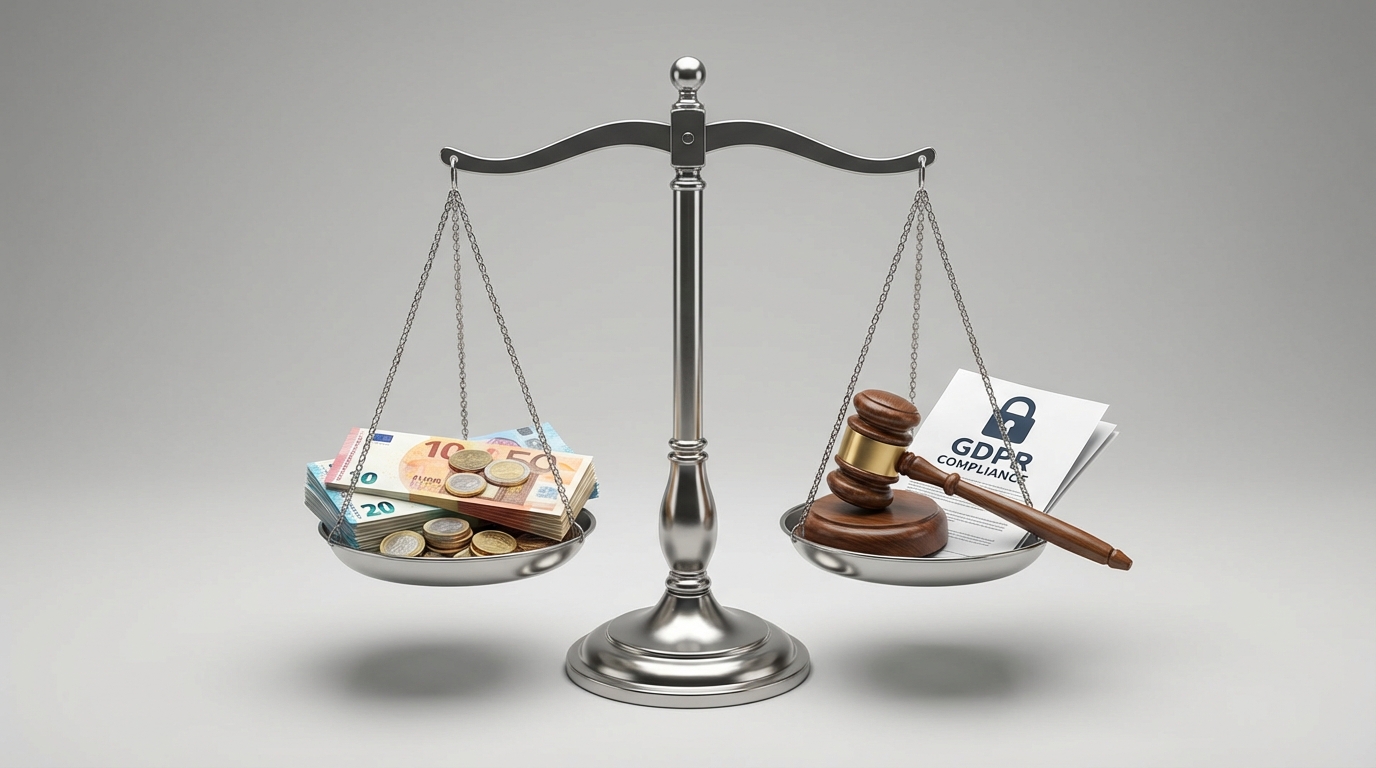
GDPR Fines in Practice: Notable European Cases
The theoretical maximums for GDPR fines are now a firm reality. Since the regulation’s implementation, Data Protection Authorities (DPAs) across the European Union have imposed substantial penalties, demonstrating a clear commitment to enforcement. Examining these cases provides valuable insight into how regulators penalize different types of infringements. According to the GDPR Enforcement Tracker, the total value of fines has surpassed several billion euros, signaling the serious financial risks of non-compliance.
Here are some significant examples of GDPR fines that highlight the broad scope of enforcement actions:
- Meta Platforms Ireland Limited: In 2023, the Irish Data Protection Commission (DPC) imposed a record-breaking fine of €1.2 billion on Meta. The penalty was for transferring the personal data of European users to the United States without ensuring adequate protection, which violated GDPR’s data transfer requirements.
- Amazon Europe Core S.à r.l.: Luxembourg’s National Commission for Data Protection (CNPD) fined Amazon €746 million in 2021. The authority found that the company’s advertising-targeting system processed personal data without a sufficient legal basis, which is a breach of core GDPR principles.
- H&M Hennes & Mauritz: The Data Protection Authority of Hamburg, Germany, issued a €35.3 million fine to the clothing retailer H&M in 2020. The company was penalized for the extensive and illegal monitoring of its employees, which included collecting private details about their health and personal lives.
- Österreichische Post AG (Austrian Post): The Austrian Data Protection Authority (DSB), found on their official website at www.dsb.gv.at, fined the Austrian Post €9.5 million in 2021. The fine was issued because the company had created profiles of the presumed political affiliations of millions of Austrian citizens for marketing purposes without their consent.
GDPR Fine Tiers by Violation Type
To better understand the financial risks, it is helpful to see how different types of GDPR violations are categorized into the two main fining tiers. The following table provides a clear overview of the potential penalties associated with specific non-compliance issues. As the table illustrates, infringements of core data protection principles and individual rights attract the highest level of fines.
| Violation Category | Maximum Fine | Common Examples of Non-Compliance |
|---|---|---|
| Core Principle Violations | Up to €20 million or 4% of global annual turnover | – Processing data without a valid legal basis (e.g., no consent). – Violating principles of transparency, purpose limitation, or data minimization. |
| Data Subject Rights Infringements | Up to €20 million or 4% of global annual turnover | – Failing to honor requests for data access, rectification, or erasure. – Making it difficult for individuals to exercise their rights. |
| Unlawful International Data Transfers | Up to €20 million or 4% of global annual turnover | – Transferring personal data outside the EEA without a valid mechanism like an adequacy decision or Standard Contractual Clauses. |
| Administrative & Security Failures | Up to €10 million or 2% of global annual turnover | – Not reporting a data breach to the supervisory authority within 72 hours. – Failing to implement appropriate technical and organizational security measures. – Not maintaining proper Records of Processing Activities (RoPA). |
Conclusion: Proactive Compliance is the Best Defense
As we have seen, the landscape of GDPR enforcement is both strict and continuously evolving. The process of GDPR fines calculation is not a simple matter of applying a fixed formula; it is a complex assessment based on a wide array of factors, including the severity of the infringement, the level of negligence, and the cooperativeness of the organization involved. For businesses in Austria, understanding these nuances is no longer just a legal formality but a critical component of financial risk management. The substantial fines levied by authorities across the EU serve as a clear warning that non-compliance has serious consequences.
The ongoing developments in CJEU case law further underscore the need for vigilance. As courts demand more transparent and justified penalty calculations from supervisory authorities, organizations must, in turn, be able to provide clear evidence of their own diligence and accountability. This requires a shift from a reactive to a proactive stance on data protection.
Ultimately, the goal should not be simply to avoid fines but to cultivate a robust culture of data privacy. By investing in comprehensive compliance programs, conducting regular risk assessments, and staying informed about the latest legal interpretations, businesses can protect themselves from penalties while also building greater trust with their customers. In the modern digital economy, this commitment to data protection is not just a legal obligation but a powerful business asset.
Frequently Asked Questions (FAQs)
How is the exact amount of a GDPR fine calculated?
There is no fixed formula for GDPR fines calculation. Instead, supervisory authorities conduct a case-by-case assessment based on the criteria outlined in Article 83 of the GDPR. They consider multiple factors, including the nature and gravity of the infringement, whether it was intentional or due to negligence, the number of individuals affected, and the categories of personal data involved. Actions taken by the organization to mitigate the damage and the level of cooperation with the authority are also key considerations. The final amount must be effective, proportionate, and dissuasive.
What are the most common violations that lead to GDPR fines?
Fines are most frequently triggered by fundamental failures in data protection. The most common reasons include processing personal data without a valid legal basis (such as clear and informed consent), failing to implement adequate security measures to prevent data breaches, not respecting the rights of data subjects (like the right to access or erase their data), and unlawfully transferring data outside of the European Economic Area.
Can small businesses also receive large GDPR fines?
Yes, the GDPR applies to all organizations that process the data of EU residents, regardless of their size. However, the principle of proportionality is central to the GDPR fines calculation. This means that when determining a fine, regulators will take into account the size and financial resources of the business. While a small business is unlikely to face a penalty on the scale of a large corporation, the fine will still be significant enough to be a deterrent.
What are the best proactive steps to avoid GDPR fines?
Avoiding fines requires a commitment to proactive compliance. Essential steps include implementing a robust data governance framework, conducting regular data protection impact assessments (DPIAs) for high-risk processing, and providing ongoing GDPR training for all staff. It is also crucial to have strong technical and organizational security measures in place, along with clear procedures for responding to data breaches and handling data subject requests efficiently.
Does having a Data Protection Officer (DPO) prevent fines?
Appointing a Data Protection Officer is a key component of accountability and is mandatory for many organizations. While having a DPO does not guarantee immunity from fines, it demonstrates a serious commitment to data protection. A knowledgeable and empowered DPO can help identify and mitigate risks, oversee compliance activities, and act as a point of contact with supervisory authorities, all of which can be considered mitigating factors in the event of an infringement.
The information provided here constitutes general and non-binding legal information that makes no claim to be current, complete, or accurate. All non-binding information is provided exclusively as a public and free service and does not establish a client-attorney or consulting relationship. For further information or specific legal advice, please contact our law firm directly. We therefore assume no guarantee for the topicality, completeness, and correctness of the provided pages and content.
Any liability claims relating to damages of a non-material or material nature caused by the publication, use, or non-use of the information presented, or by the publication or use of incorrect or incomplete information, are fundamentally excluded, provided there is no demonstrable willful intent or grossly negligent conduct. For additional information and contact, please refer to our Legal Notice (Impressum) and Privacy Policy.