
Navigating the Expanding Reach of EU Law in the Digital Age
The regulatory landscape for digital services is undergoing a profound transformation, driven largely by the Court of Justice of the European Union (CJEU). A critical element in this evolution is the steady expansion of CJEU platform jurisdiction, which directly influences how digital platforms operate across the European Union. This expanding authority creates a complex legal framework that national authorities must navigate carefully. Consequently, understanding the nuances of these judicial interpretations is no longer optional but essential for legal practitioners.
For Member States like Austria, the implications are immediate and significant. Rulings from the CJEU require Austrian courts and regulators to constantly reassess and align their domestic enforcement of internal market and data governance rules. The core principles of EU law, including primacy and direct effect, compel national bodies to adapt to a unified standard, ensuring consistent application of regulations such as the Digital Services Act and the Data Governance Act. This article explores the ongoing expansion of the CJEU’s authority and its direct consequences for Austria’s legal and regulatory frameworks.
Understanding the Foundations of Jurisdiction
In the legal world, jurisdiction refers to the authority of a court or judicial body to hear and decide on legal disputes. This authority can be limited by geographical area, the subject matter of the case, or the parties involved. Within the European Union, this concept is particularly complex, as it involves a multi-layered system of national courts and the overarching authority of the Court of Justice of the European Union (CJEU). The CJEU’s role is to ensure that EU law is interpreted and applied uniformly across all Member States, creating a consistent legal framework for the internal market.
The Scope of CJEU Platform Jurisdiction
The term CJEU platform jurisdiction describes the Court’s expanding power to interpret and enforce EU regulations governing digital platforms. This authority is not exercised in isolation; rather, it is most frequently asserted through the preliminary ruling procedure. Under this mechanism, a national court facing a question about the interpretation of EU law can—and sometimes must—refer the question to the CJEU. The resulting ruling is binding not only on the national court that made the reference but on all courts across the EU. This process is crucial for clarifying the obligations of platforms under regulations like the General Data Protection Regulation (GDPR) and the Digital Services Act (DSA).
Key insights for businesses operating multinational platforms include:
- Uniformity Over National Variation: CJEU rulings establish a single, authoritative interpretation of EU law. This means platform operators must align their compliance strategies with the CJEU’s standards, which supersede any conflicting national provisions.
- Pan-European Precedent: A decision arising from a legal challenge in one Member State has immediate and binding effects across the entire Union. Therefore, companies must monitor legal developments EU-wide, as a case in one country can reshape their obligations everywhere.
- Empowering National Regulators: Clear rulings from the CJEU often empower national authorities in countries like Austria to enforce EU data governance and internal market rules more confidently and consistently.
- Proactive Compliance is Essential: Relying solely on local legal interpretations is insufficient. Businesses must proactively track CJEU jurisprudence to anticipate regulatory trends and adapt their operational policies to remain compliant. Further details on this procedure can be found on the Court of Justice’s official website.
Platform Jurisdiction Rules in Key EU Member States
| Member State | Applicable Jurisdiction Rules | Relevant Cases or Legal References | Practical Implications for Platforms |
|---|---|---|---|
| Germany | Strong enforcement of national content moderation laws (like the former NetzDG, now aligned with the DSA) and data protection. | CJEU in Case C-18/18 (Glawischnig-Piesczek), which allows courts to order worldwide removal of content. See Judgment. | Platforms face stringent requirements for content moderation and must be prepared for injunctions with potential global effect, underscoring the reach of CJEU platform jurisdiction. |
| France | Aggressive enforcement of the GDPR by the data protection authority, the Commission Nationale de l’Informatique et des Libertés (CNIL). | Numerous CNIL decisions imposing fines for non-compliance with data privacy and cookie consent rules. CNIL Website. | Strict compliance with EU data privacy standards is critical. France’s proactive enforcement signals a low tolerance for ambiguity in platform data handling practices. |
| Ireland | The “one-stop-shop” mechanism under the GDPR, positioning the Irish Data Protection Commission (DPC) as the lead supervisory authority for many major tech platforms headquartered there. | CJEU in Case C-311/18 (Schrems II), which originated from a complaint to the Irish DPC and invalidated the EU-US Privacy Shield. See Judgment. | While streamlining regulation through a lead authority, platforms are at the center of high-stakes, pan-European data protection cases that often escalate to the CJEU. |
| Austria | Direct and consistent application of EU regulations, with national courts frequently referring questions on digital services and data protection to the CJEU. | National laws like the Austrian eCommerce Act fully incorporate EU principles. See Legislation. | Platforms must operate with the assumption that all EU digital regulations will be enforced directly and that Austrian courts will actively seek CJEU guidance, ensuring alignment with EU-level jurisprudence. |
Practical Business Implications of CJEU Platform Jurisdiction
The expanding scope of CJEU platform jurisdiction has moved beyond theoretical legal debate and now carries significant, practical consequences for any business operating a digital platform within the EU. These rulings directly shape day-to-day operations, contractual obligations, and strategic planning. Companies must therefore adapt to a legal environment where compliance is dictated by a supranational judicial body, not just local laws.
Understanding these implications is crucial for mitigating risk and ensuring sustainable cross-border operations. Key areas affected include:
- Contractual Agreements: Platform terms of service, privacy policies, and user agreements must be treated as living documents. Rulings from the CJEU can render certain clauses unenforceable across the entire EU overnight. For example, a decision on unfair contract terms in a case from one Member State will require all platforms to review and potentially amend their standard agreements to align with the new precedent.
- Dispute Resolution: The CJEU consistently prioritizes consumer protection, which can impact jurisdiction clauses in business-to-consumer contracts. A platform may find its chosen forum for dispute resolution overridden in favor of the consumer’s home court. Businesses are also required to provide accessible mechanisms for resolving disputes, such as linking to the European Commission’s Online Dispute Resolution platform.
- Cross-Border Business Operations: A unified legal interpretation from the CJEU means that a fragmented, country-by-country compliance strategy is no longer viable. Businesses must adopt a centralized approach to ensure their services, content moderation policies, and data handling procedures are consistent with EU-wide standards. A ruling on data access in Austria, for example, will set the standard for operations in all other Member States.
- Data Governance: CJEU decisions have profoundly impacted international data flows. The invalidation of the EU-US Privacy Shield in the Schrems II case forced thousands of businesses to re-evaluate their legal basis for transferring personal data, leading to significant operational and contractual adjustments.
The Way Forward: Embracing a Unified Regulatory Landscape
The digital single market is increasingly governed not by a patchwork of national laws, but by a cohesive legal framework interpreted and enforced by the Court of Justice of the European Union. As this article has demonstrated, the expansion of CJEU platform jurisdiction is the single most significant factor shaping the obligations of digital platforms operating within the Union. Its rulings create binding precedents that harmonize rules on everything from data protection to content moderation, directly impacting national enforcement in Member States like Austria.
For businesses, the primary takeaway is unequivocal: a reactive, country-specific approach to compliance is no longer viable. The legal ground can shift dramatically with a single ruling from Luxembourg, rendering previously acceptable practices obsolete across all Member States. Therefore, proactive engagement with CJEU jurisprudence is essential for sustainable operations. Companies must treat EU law not as a distant consideration but as a core component of their risk management and strategic planning. A forward-looking compliance strategy, informed by prudent legal evaluation, is the most effective tool for navigating this dynamic and increasingly centralized regulatory environment.
Frequently Asked Questions (FAQs)
What exactly is meant by ‘CJEU platform jurisdiction’?
‘CJEU platform jurisdiction’ refers to the authority of the Court of Justice of the European Union to provide the ultimate interpretation of EU laws that govern digital platforms. It is not a court of first instance where cases are filed directly. Instead, its jurisdiction is exercised primarily when national courts refer questions about EU law for a definitive ruling. This ensures that regulations like the Digital Services Act or the GDPR are applied uniformly across all 27 Member States, creating a single, predictable legal standard for the entire digital single market.
How does a dispute involving a platform typically reach the CJEU?
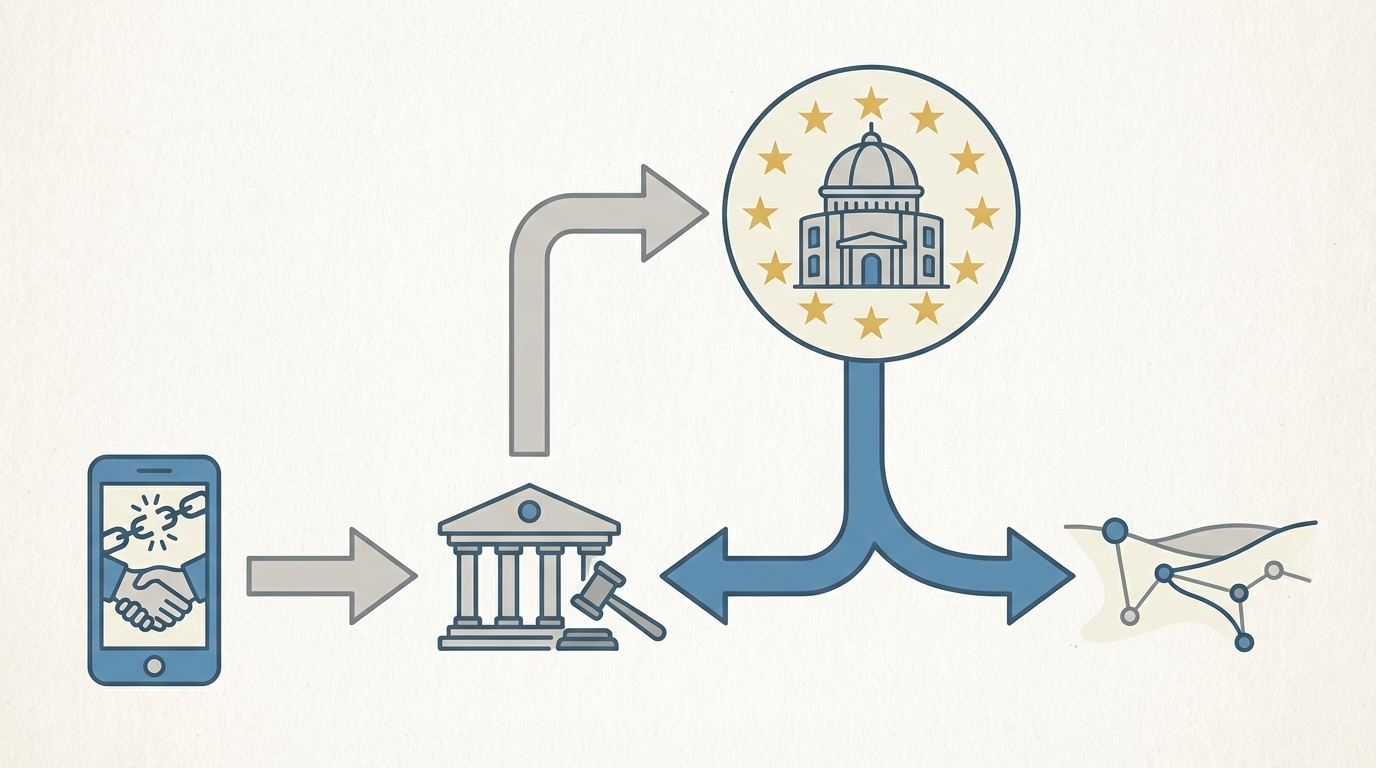
The most common pathway is the preliminary ruling procedure. When a national court in a Member State, such as Austria, is handling a case and encounters a novel or unclear question about how to apply an EU regulation to a digital platform, it can suspend the national case and refer the legal question to the CJEU. The CJEU then issues a binding interpretation, or ‘ruling,’ which the national court must follow to decide its case. This mechanism ensures consistent legal interpretation across the Union.
Does CJEU platform jurisdiction impact companies that are not based in the EU?
Yes, absolutely. Any company, regardless of where it is headquartered, that offers services or products to users within the European Union is subject to EU law. For example, a US-based social media platform with users in Germany or France must comply with the GDPR. As a result, it is also directly affected by how the CJEU interprets the GDPR’s requirements. Location of the company is secondary to the location of its users.
Why isn’t it enough to just follow the national laws of each EU country?
This is due to the foundational principle of the ‘primacy of EU law.’ This legal doctrine establishes that EU law has supremacy over any conflicting national laws of the Member States. Because the CJEU is the final arbiter of what EU law means, its rulings set the standard that all national courts and regulators must adhere to. Relying solely on local legislation can expose a business to significant risk if that legislation is found to be incompatible with the CJEU’s interpretation of EU-wide rules.
What is the best way for a business to stay up-to-date with CJEU rulings?
Proactive monitoring is key. Businesses should regularly consult the official website of the Court of Justice of the European Union (CURIA) for judgments and press releases. Additionally, subscribing to legal news services that focus on EU law, and engaging with legal counsel specialized in digital regulation, are effective strategies for staying informed about the evolving jurisprudence and its practical implications.
The information provided here constitutes general and non-binding legal information that makes no claim to be current, complete, or accurate. All non-binding information is provided exclusively as a public and free service and does not establish a client-attorney or consulting relationship. For further information or specific legal advice, please contact our law firm directly. We therefore assume no guarantee for the topicality, completeness, and correctness of the provided pages and content. Any liability claims relating to damages of a non-material or material nature caused by the publication, use, or non-use of the information presented, or by the publication or use of incorrect or incomplete information, are fundamentally excluded, provided there is no demonstrable willful intent or grossly negligent conduct.
For additional information and contact, please refer to our Legal Notice (Impressum) and Privacy Policy.